

Jewelry eCommerce specialists · 18 years · USA
Jewelry website redesign for U.S. jewelers
You already have a site. We fix the part that isn’t working — diamond search, ring builders, supplier catalogs, POS sync, mobile.
- Keep your platform
- Keep your URLs
- Own your code
★ 5.0 on Clutch · ★ 4.7 on Google · Clients in NYC, LA, Chicago, D.C., San Francisco & Texas
Start small or go big
Three ways jewelers work with us
You don’t have to commit to a rebuild. Most projects start smaller than the client expected.
Your storefront stays as it is. We build the missing piece — diamond search, a ring builder, a supplier feed, appointment booking, a custom-design form.
Most U.S. projects start here.
Keep your Shopify, WooCommerce, Magento, or PrestaShop install. Rebuild the design, navigation, product pages, filters, and mobile experience on top of it.
Magento, WooCommerce, BigCommerce, or Wix to Shopify — plus older carts onto Magento, OpenCart, or PrestaShop. See migrations.
On migrations: we map every existing URL to its new address and put the redirects live on day one, then watch Search Console with you for 90 days. We won’t promise your rankings never wobble — anyone who does is guessing. We will promise nothing gets lost because a URL was forgotten.
Working software, not mockups
Try it before you call us
Live demos on four platforms. Search the diamonds. Build a ring. Open them on your phone.
Sound familiar?
When jewelers usually call us
Each one is something we can assess on your live site before you spend anything.
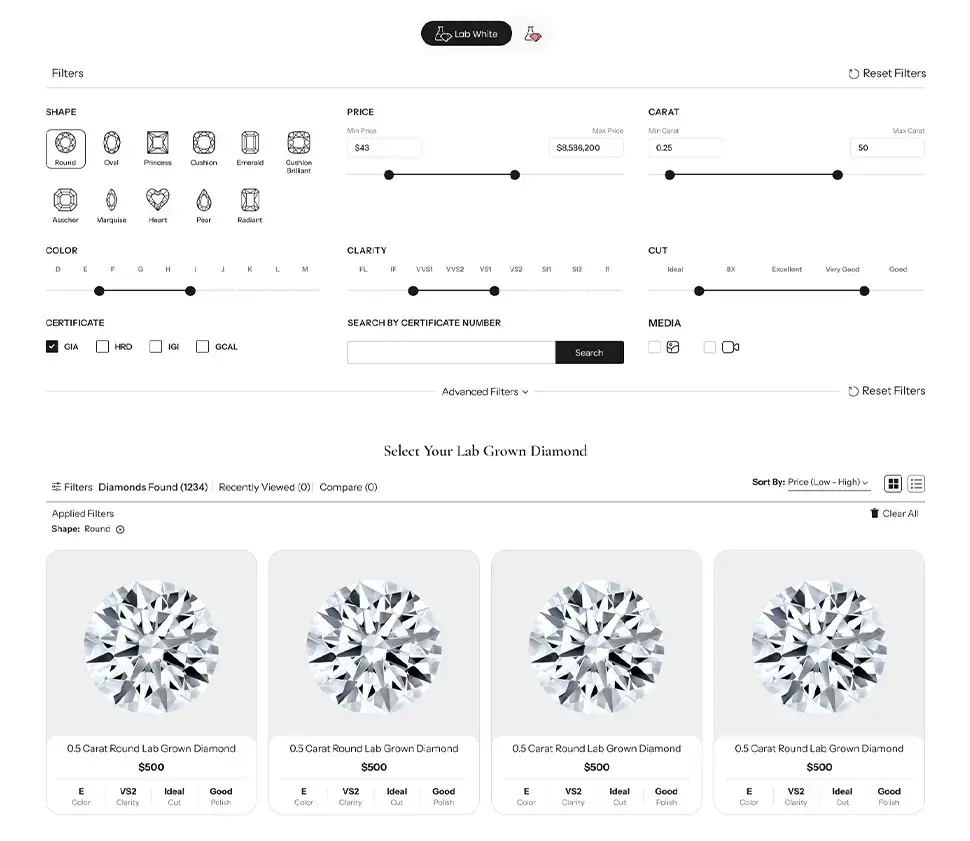
Filters don’t match how people shop. A 1.2ct oval under $6,000 takes eleven clicks to find.
Filters that need a mouse. A ring builder that needs pinch-zoom. A nine-tap checkout.
A weekly spreadsheet. A manual price change when gold moves. A stone still listed a month after it sold.
You close in person, but the site can’t book an appointment or start a custom-design conversation.
Search from one vendor, ring builder from another, neither matching your brand.
You’ve been told something isn’t possible. Often it is — the last developer just wasn’t a jewelry specialist.
Segment one
If you sell diamonds
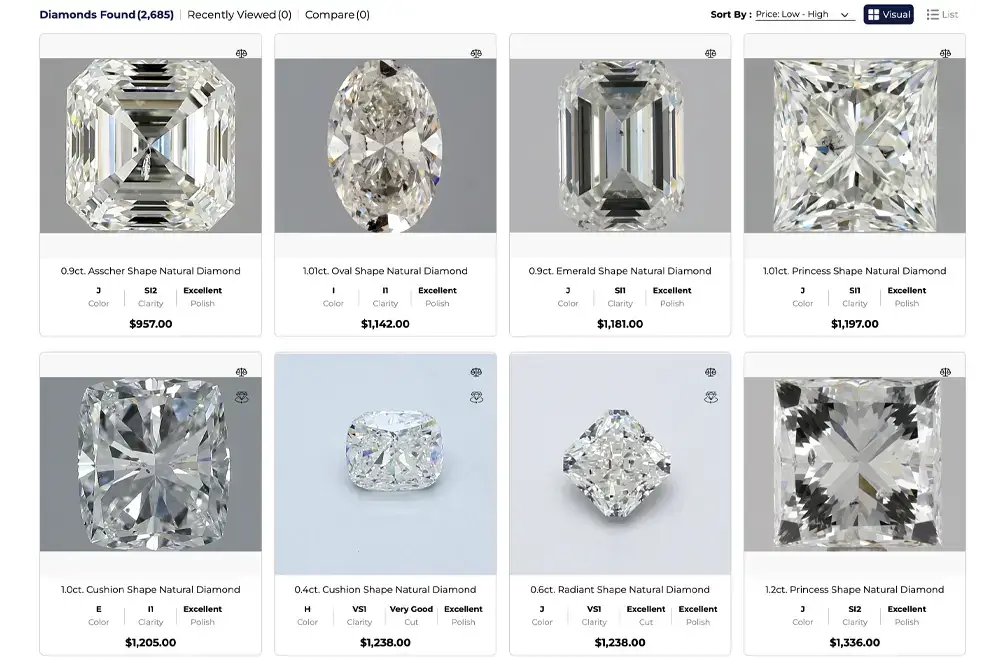
Natural, lab-grown, or both — from your own vault, a supplier feed, or a mix.
-
Your site matches your supplierA customer finds a 1.51ct H VS1 Tuesday, emails Wednesday — and it sold Monday. We re-sync on a schedule, drop stones that are sold or on memo out of search, and add a live availability check at cart or inquiry where the API supports it.
-
Markup rules you set onceBy shape, carat band, color, clarity, or supplier. Floor prices so thin-margin stones never publish. Separate rule sets for natural and lab-grown — different pricing logic, different rules.
-
Certificates, video, disclosureGIA, IGI, or GCAL report links plus supplier 360° video on the stone page. Lab-grown and treatment disclosure fields where the FTC guides call for them — we build the fields, your counsel approves the wording.
-
Help them choose, not just filterSide-by-side comparison, saved shortlists that survive a session, email-this-stone. And settings that only show center stones they genuinely take.
Feeds: RapNet · Nivoda · IDEX · VDB · Stuller · Polygon · your own inventory
Segment two
If you sell colored gemstones
Colored stone isn’t diamond with a different filter set. Two 3ct blue sapphires can differ tenfold in price, and none of the reasons fit a diamond schema.
Gem type and variety, color family, shape, cut, carat, and measured dimensions — filterable in that order.
Shown only where you hold verified information. Empty beats guessed. Lab reports from AGL, GRS, or Gübelin as linked documents.
A pair stays a pair in the cart. When a stone sells the page keeps its URL, says sold, and shows comparable stones — instead of a 404.
One honest note. RapNet, Nivoda, IDEX, and VDB are diamond feeds — they don’t carry colored inventory, and no integration changes that. A colored catalog is built from your own stock, or a supplier connection we’d assess first. Send us the source and we’ll tell you straight whether it can be connected.
Segment three
If you sell finished jewelry
Bridal, fine, fashion, or estate — usually with a showroom as well as a website.
-
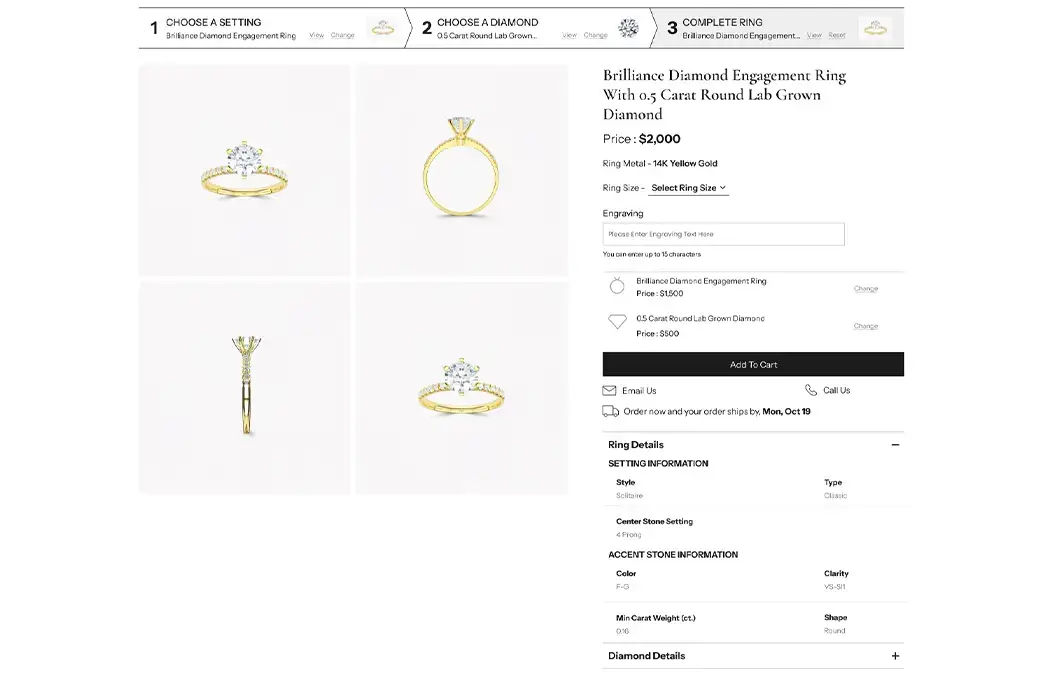
Filters customers actually useMetal, karat purity, center and accent stones, style, ring size, budget.
-
Variants that stay manageableFour metals × three purities × 28 sizes is 336 combinations. Built properly, the customer sees four clear choices and a price that updates as they pick.
-
Engraving & personalizationLive character count, preview, and its own price, lead time, and returns rule — stated before they commit.
-
Appointments & reserve-to-try-onBooking against real availability — bridal consultation, custom design, trunk show, private viewing — plus ZIP-based local pickup and a quieter path for high-value inquiries.
Fits your existing stack
Connects to what you already run
Your website isn’t the only system in the store. These are the connections American retailers ask us for most.
We connect stores running Shopify POS and Lightspeed, so counter and online inventory stay in step.
On The Edge, Jewel360, or another jewelry POS? Tell us what you run and we’ll assess what can sync — before you commit to anything.
Stuller’s full catalog — mountings, findings, chain, ready-to-ship — plus Quality Gold, Royal Chain, Rembrandt, and Midas Chain.
Buying through RJO, IJO, or Continental? Your vendor mix shapes how the catalog gets built.
We configure the providers you already work with — financing through Synchrony, Wells Fargo, Affirm, Klarna, or Afterpay; coverage through Jewelers Mutual or BriteCo; insured shipping via Parcel Pro or Malca-Amit. Approval and terms stay between you and them.
★ Built for American retail
The details a generalist gets wrong
We’re based in Navi Mumbai, India. No U.S. office, and we won’t pretend otherwise. What we have is eighteen years of building for American jewelers.
Including the per-carat-to-per-stone math on supplier feeds, where wrong prices usually start.
Numeric with half and quarter sizes. Printable sizers in inches. Conversions kept out of your Americans’ way.
State dropdown, 5- or 9-digit ZIP, (555)123-4567 phone format, ZIP lookup for local pickup.
Cards, Apple Pay, Shop Pay, PayPal, and Affirm, Klarna, or Afterpay. We configure what your gateway approves — we don’t control approval.
You pick the service — Shopify Tax, Avalara, TaxJar. We configure it to your nexus states and rules. We implement; we’re not your tax advisor.
9a.m. in New York is 6:30p.m. for us in daylight time. East Coast calls are routine. You get a named person, not a ticket queue.
Keyboard-navigable filters, labeled form fields, sufficient contrast, ring builder steps a screen reader can follow. We can’t give you a legal guarantee — any developer who does is selling you something.
Consent handling and a “Do not sell or share my personal information” link for California and the states that followed. We build the mechanism; the policy is yours.
Evidence, not adjectives
U.S. jewelers we’ve worked with
Every quote below is on our public Clutch profile, written by the client — not by us.
“They met all our needs on time.”
Greg Dolkarian, DercoWooCommerce store with diamond search · Jan–Apr 2025
“They’re specialists and niche in a way that makes them more aware of challenges.”
Furqan Shafi, TheGoodCaratRing builder added to an existing store
“One of the best development teams I’ve ever worked with.”
Andrew Elawar, Founder & CEOFull platform build · Jan–Oct 2025 · $10k–$50k







No discovery-phase surprises
How a project runs
We don’t launch in your Q4. Engagement season and the holidays carry your year, so we hold migrations and major launches from mid-October through the new year unless you tell us otherwise. We raise it when we scope the work — not after you’ve signed.
Starting points, not estimates
What it costs
Published starting prices in USD. One-time payment, one year of support, and you own the code.
What moves the number
How many diamond feeds or supplier catalogs, and how well documented. Whether your product data needs restructuring. How customized your theme is. Catalog size — 50,000 stones needs caching work that 2,000 doesn’t.
Never marked up
Platform subscription, paid apps, supplier API accounts, theme licenses, processing fees. Smaller than these tiers? Say so — our minimum is $1,000. Full pricing →
Straight answers
Questions U.S. retailers ask
Can you work on our Shopify store without rebuilding it?
Yes — that’s most of what we do. Your theme, apps, order history, and URLs stay where they are.
Can you add diamond search without touching the rest of the site?
Usually. It becomes a new section with its own pages, styled to match your theme. The rest of your catalog carries on unchanged.
We buy from a supplier you haven’t listed. Can you connect them?
Often. It depends on whether they offer an API or a scheduled data file, and what’s in it. Send us their name and we’ll tell you what’s possible before you commit.
What happens to our Google rankings if we migrate?
We map every URL to its new address, put redirects live at launch, and monitor Search Console with you for 90 days. Traffic moves around for a few weeks after any migration — that’s normal. Losing a page because nobody wrote down it existed isn’t, and that’s what we prevent.
Who owns the code?
You do. One-time payment, no ongoing license, no lock-in. If you move to another developer, everything goes with you.
How do meetings work with a team in India?
Email plus a scheduled call, usually weekly during a build. We work evenings to cover the U.S. East Coast morning, and you get a named contact rather than a support queue.
One step
Show us your current website
Send the URL and tell us what you’d change. We’ll look at the live site and come back with what we think is going on, what it would take to fix, and roughly what it would cost.
- No obligation, no sales sequence
- We’ll say so if the job is smaller than you think
- We’ll say so if it isn’t worth doing