
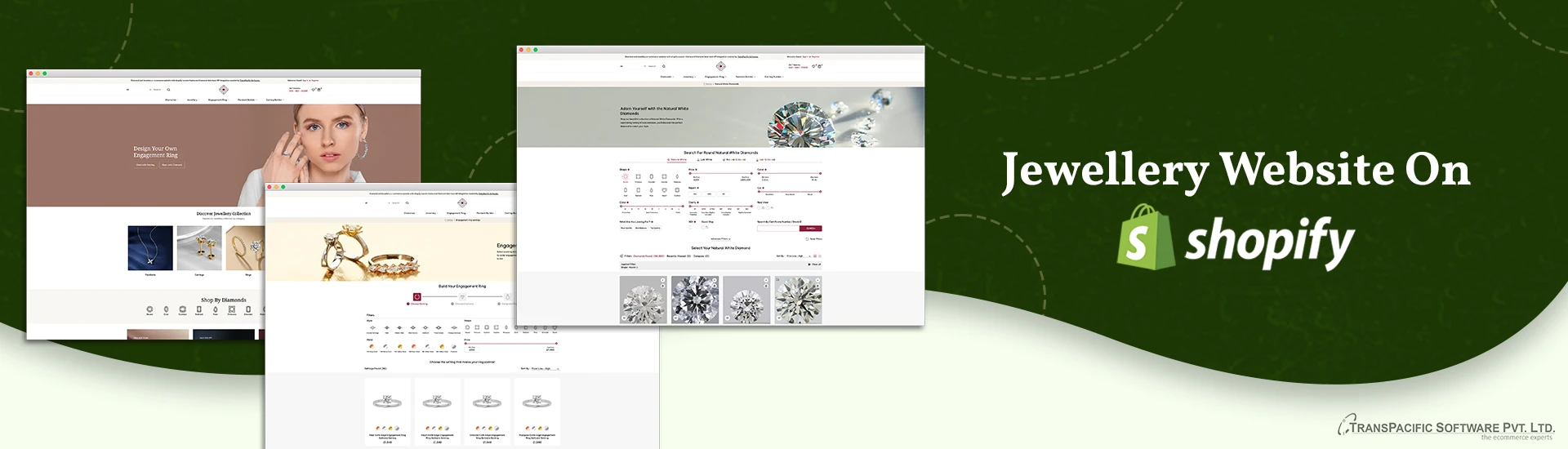
Shopify Jewelry Store
how to create a successful jewelry store on shopify
A Step-by-Step Guide
The pandemic accelerated the shift to eCommerce, pushing many brick-and-mortar jewelry retailers online. Shopify, one of the leading eCommerce platforms, emerged as a top choice, now powering over 20% of the market share.
If you're planning to launch a jewelry store on Shopify, this guide will walk you through why Shopify is a great option, key features to consider, and best practices for a seamless setup.
Why Choose Shopify for Your Jewelry eCommerce Store?
Shopify is a hosted platform designed for ease of use, making it an excellent choice for jewelry retailers who want a stylish and functional website without extensive coding or technical expertise.
Pros of Shopify for Jewelry Stores:
- User-Friendly: No need for complex coding—Shopify's intuitive interface simplifies management.
- Secure & Reliable: Hosted infrastructure ensures fast loading speeds, security, and automatic updates.
- Extensive App Marketplace: Expand functionality with apps for reviews, appointment booking, and more.
- Seamless Payment Integration: Accept credit cards, PayPal, and even cryptocurrency with ease.
- Mobile-Optimized: Shopify themes are fully responsive, ensuring a great shopping experience on any device.
- Multi-Currency Support: Sell globally with automatic currency conversion for over 130 currencies (e.g., USD, EUR, JPY). Customers see prices in their local currency at checkout.
- Multi-Language Support: Shopify’s native multi-language feature (via Shopify Markets) lets you translate your store into multiple languages (e.g., French, Spanish, Mandarin). Pair it with shopify inbuilt apps like Langify for deeper customization.
- Point of Sale (POS) Integration: Shopify POS syncs your online and in-person sales easily.
Limitations to Consider:
- Customization Constraints: Shopify's Liquid coding language means heavy customization requires a developer.
- Subscription-Based Costs: Shopify pricing scales with business size, which may become expensive.
- Limited B2B Features: For wholesale pricing, bulk ordering, or membership programs, WooCommerce or Magento might be a better fit.
- App Dependency: Many advanced features (e.g., SEO, analytics, marketing) rely on third-party apps, which can increase monthly expenses and complicate maintenance if apps conflict or aren’t updated regularly.
- Checkout customization: Once a Plus-only feature, checkout can now be branded and extended on any plan through Checkout Extensibility (app blocks, branding API, custom fields, Functions); only the deepest code-level control still favours Shopify Plus. Note that legacy checkout.liquid was deprecated, with a 26 August 2026 migration deadline for non-Plus stores — stores that missed it can lose post-purchase tracking scripts until they're rebuilt as extensions.
Choosing the Right Shopify Plan
Shopify offers three main pricing tiers:
- Ideal for
- Startups and small businesses just entering eCommerce.
- Key Features
- Full online store, unlimited products, 24/7 support, and basic reports (owner login only — no additional staff accounts). Shipping discounts and omnichannel selling across social media and marketplaces.
- Transaction Fees
- Online (Shopify Payments): 2.9% + 30¢ (US) · 2% + 25p (UK). In-person: 2.6% + 10¢ (US) · 1.7% (UK). Add 2% when using a third-party gateway instead of Shopify Payments.
- Ideal for
- Growing businesses needing more robust tools and insights.
- Key Features
- Everything in Basic, plus professional reports, up to 5 staff accounts, gift cards, and abandoned cart recovery. Higher shipping discounts and support for international markets.
- Transaction Fees
- Online (Shopify Payments): 2.7% + 30¢ (US) · 1.7% + 25p (UK). In-person: 2.5% + 10¢ (US) · 1.6% (UK). Add 1% with third-party gateways.
- Ideal for
- Scaling businesses with high sales volumes and complex needs.
- Key Features
- Everything in Grow, plus advanced analytics with custom reports, up to 15 staff accounts, third-party calculated shipping rates, and eCommerce automation. Best shipping discounts.
- Transaction Fees
- Online (Shopify Payments): 2.5% + 30¢ (US) · 1.5% + 25p (UK). In-person: 2.4% + 10¢ (US) · 1.5% (UK). Add 0.6% with third-party gateways.
- Ideal for
- High-growth, enterprise-level businesses with complex, large-scale operations.
- Key Features
- Unlimited bandwidth, unlimited staff accounts, multiple stores, advanced APIs, fully customizable checkout (Shopify Functions/Scripts), and tools like Shopify Flow (automation) and Launchpad. Includes wholesale/B2B, up to 200 POS Pro locations, and 24/7 priority support with a dedicated Merchant Success Manager.
- Pricing Details
- Starts from $2,300/mo (US) / £1,800/mo (UK) on a 3-year term. High-volume merchants shift to a revenue-based rate (approx. 0.3%–0.4% of monthly revenue above a threshold, capped). Contact Shopify for a tailored quote.
- Transaction Fees
- Most competitive rates — from 2.15% + 30¢ online (US, Shopify Payments); negotiable for high-volume merchants.
Start with Basic Shopify and upgrade as your store grows.
Designing Your Jewelry Store
Selecting the Right ThemeWhile Shopify offers ready-made themes, some may contain unnecessary JavaScript, slowing down your site. For a fast-loading, SEO-friendly jewelry store, consider:
- Premium Shopify Themes – Available on ThemeForest and Shopify’s theme store.
- Custom Development – Work with a Shopify agency to create a tailor-made theme optimized for speed and user experience.
- High-Quality Images & Videos: Display jewelry from multiple angles.
- 3D & AR Models: Integrate interactive 3D models in GLB/GLTF format using Shopify’s ModelViewer component.
- Clear Product Descriptions: Highlight details like metal type, gemstone specifications, and customization options.
Managing Product Data & Inventory
Organizing your product data properly before launch ensures smooth store management.
- Simple Products: Ready-to-wear items (e.g., ring, necklace, bracelets, pendants and earrings).
- Variable Products: Customizable jewelry (e.g., engagement rings with multiple metal & diamond shape options).
- Organize SKUs, pricing, and attributes in a spreadsheet before uploading.
- Use high-resolution images (minimum 1000x1000 pixels) for a professional look.
- Ensure clear, SEO-friendly product titles (e.g., "14K Rose Gold Diamond Engagement Ring").
TransPacific Software specializes in integrating third-party Diamond APIs into Shopify, including:
- Nivoda, RapNet, IDEXonline, VDB (for real-time diamond inventory).
- Direct supplier data feeds for up-to-date pricing and availability.
- Integrating jewelry API from Overnight Mountings & Stuller
Enhance the shopping experience with interactive jewelry customization tools:
- Ring Builder: Allow customers to choose metals, diamond shapes, and settings.
- Pendant & Earring Builder: Provide mix-and-match options for unique jewelry designs.
- Engagement Ring Product Enquiry section
- Drop a hint to friend
- Shipping days calculation to show shipping date
- Dynamic filters on product listing page as per product category show custom attributes filters
- Mega menu – Customize menu for jewelry website (With banners and icons with text)
For luxury or custom jewelry sales, offer an in-store or virtual consultation option.
Book an Appointment App (free plan available, with a 7-day trial).
- Display Google Reviews directly on product pages.
- Use Instagram Feed Apps to showcase real customer purchases.
- Shoppable Instagram Feed (starting at $50/month).
- Google Reviews App ($5.99/month).
- Qikify Smart Mega Menu App ($9.99/month, free plan also available).
- GroPulse Wishlist App (free).
- APO Product Options App for extra product options (free and paid).
Launching & Scaling Your Store
SEO & Marketing Tips for Jewelry Stores- Use long-tail keywords like "buy diamond engagement rings online" in product descriptions.
- Add meta titles & descriptions to improve search rankings.
- Run retargeting ads for visitors who browsed but didn't purchase.
- Use influencer marketing to showcase your jewelry on Instagram & Pinterest.
Shopify's SEO Limitations
Shopify's default SEO setup has some limitations For instance, it enforces a fixed URL structure—adding "product" in product URLs, "page" in informational pages, and "collection" in product listing URLs—which cannot be customized.
Shopify does support 301 redirects natively — both one at a time and in bulk via CSV import (under Content → URL redirects), with a ceiling of around 100,000 redirects on standard plans and up to 20 million on Shopify Plus. That covers most migrations comfortably. The one gap is wildcard or pattern-based redirects (for example, remapping an entire URL folder in a single rule), which still require a redirect app or custom logic. The real risk during a migration isn't a missing feature — it's mapping old URLs to the right new ones and importing them cleanly, so no ranking pages quietly fall into 404s. That URL mapping is exactly the kind of detail a specialist handles to preserve your search equity.
Shopify does include some structured data (schema markup) by default to help search engines understand your store. However, for advanced schema customization, third-party apps are required.
Several SEO plugins are available to enhance Shopify’s SEO capabilities, such as Yoast SEO, Plug In SEO, and SEO Manager.
Is Shopify the Best Choice? When to Consider Other Platforms
While Shopify is excellent for most jewelry businesses, consider WooCommerce or Magento if:
- You need multilingual & multi-currency support. Shopify has limited localization features, requiring third-party apps.
- You’re running a B2B jewelry business. Membership pricing, wholesale discounts, and sending diamonds on Memo are easier with Magento or WooCommerce.
- You need advanced customization. Shopify relies on apps for features that open-source platforms can develop in-house.
- You expect heavy traffic. Shopify pricing increases with traffic, whereas open-source platforms allow more control over hosting costs.
Demo & Live Jewelry Stores on Shopify
See what a TransPacific Software jewelry store looks like in practice, or request a tailored quote for your project.
Final Thoughts
Launching a jewelry store on Shopify can be seamless and highly profitable with the right strategy. By choosing the right theme, optimizing product data, integrating advanced features, and leveraging digital marketing,you can build a thriving online jewelry brand.
If you need expert guidance on Shopify development, TransPacific Software specializes in custom Shopify solutions, API integrations, and eCommerce SEO to help your jewelry store succeed.
💎 Need help with your Shopify store? Contact us today!