
We begin with your sales model, catalogue, team, integrations and expansion plans. Platform follows the business case.
18+ years in jewelry e-commerce
Jewelry website design built around how jewelry is sold.
The best website design for a jewelry business must do more than look luxurious. It must help buyers discover, compare, customise and confidently purchase high-value products—while your team controls suppliers, pricing and inventory behind the scenes.
18+Years of specialist experience.
Shopify, WooCommerce, Magento and PrestaShop—plus Nivoda, RapNet, IDEX, VDB, Stuller, Polygon and private feeds.
Shopify, WooCommerce, Magento and PrestaShop—plus Nivoda, RapNet, IDEX, VDB, Stuller, Polygon and private feeds.
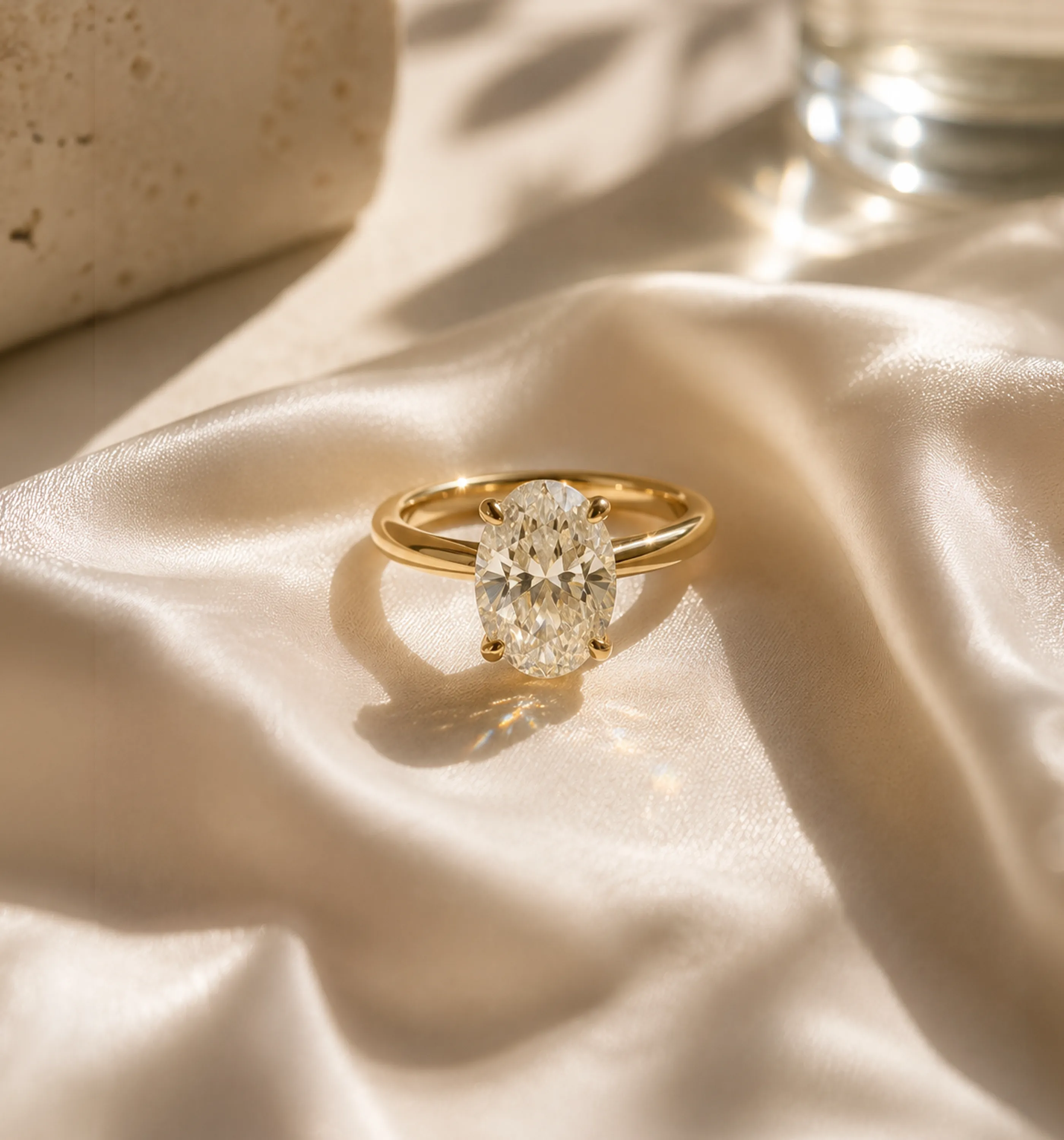
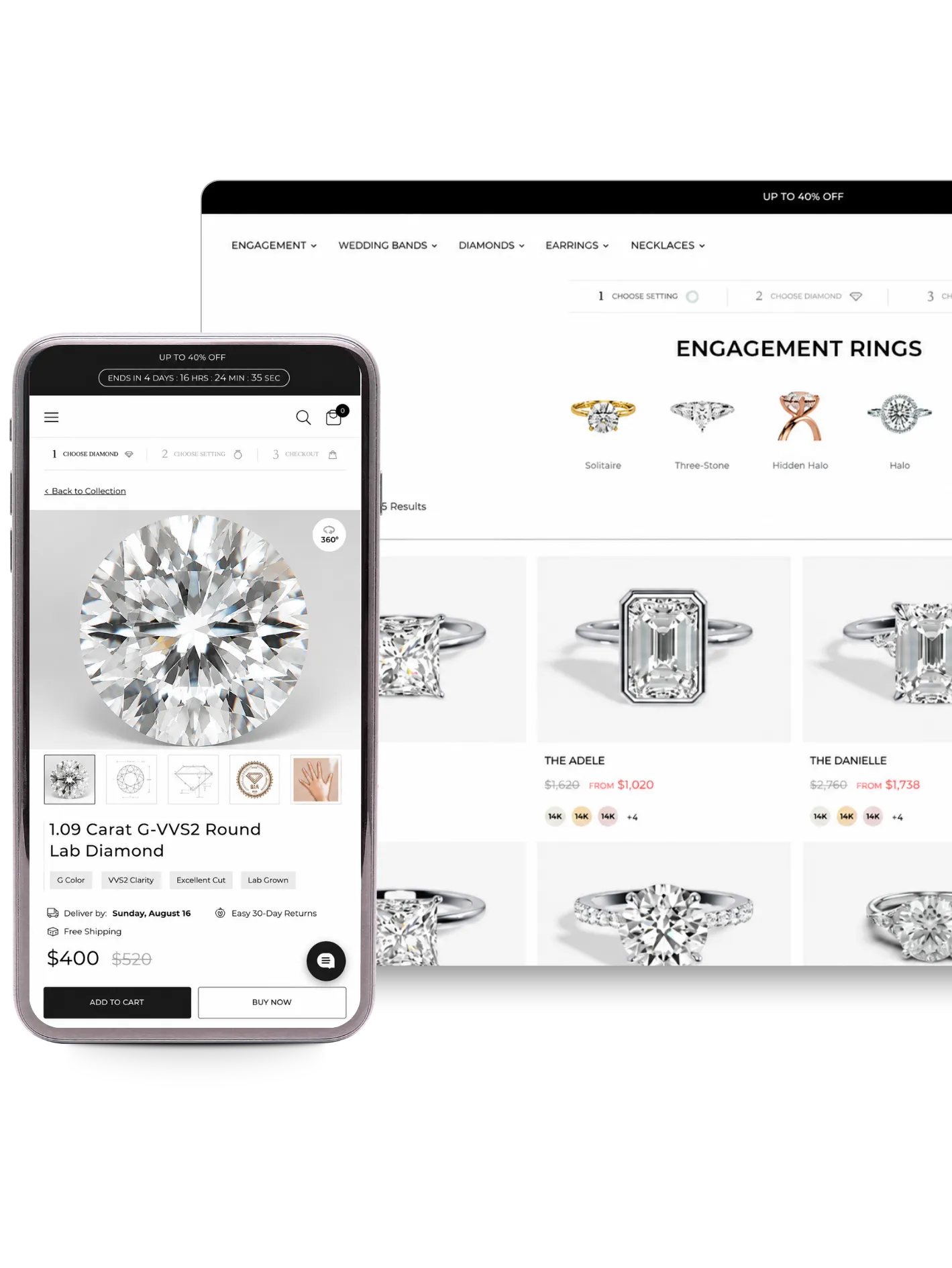 Concept visual · Product story
Find your diamond
○◇⬭⌂□
Build your ring
123
Supplier sync
Inventory & pricing live
Specialist integrationsShopifyWooCommerceMagentoPrestaShopNivodaRapNetIDEXVDBStuller

 Concept visual · Image direction
A beautiful website is not enough
Jewelry is not
Jewelry is not
ordinary retail.
A shopper is balancing emotion, technical detail and risk. The website must make a rare, expensive and deeply personal product feel understandable—and make an unfamiliar retailer feel dependable.
01High-value anxiety
Returns, warranty, certification and human help cannot be hidden.
Returns, warranty, certification and human help cannot be hidden.
02Product compatibility
A pear-shaped stone cannot be offered with every setting.
A pear-shaped stone cannot be offered with every setting.
03Complex choice
Filters must simplify thousands of stones without flattening quality.
Filters must simplify thousands of stones without flattening quality.
04Dynamic pricing
Feeds, metal rates, currencies and markups need controlled logic.
Feeds, metal rates, currencies and markups need controlled logic.
05Long decisions
Compare, save-and-share and appointments support considered buying.
Compare, save-and-share and appointments support considered buying.
06Visual proof
Consistent scale, 360° media and certificates build confidence.
Consistent scale, 360° media and certificates build confidence.
A jewelry website should help customers confidently discover, compare, customise and purchase—not merely display products.
First-hand TPS perspective
What jewelry
What jewelry
businesses ask during
discovery calls.
Retailers may begin by asking for a beautiful website. The discussion quickly moves to data, supplier feeds, margin control, compatibility and the actual purchase journey.
Yes—but it is not simply a plug-in. Supplier data must be normalised, filtered, marked up and presented inside your buying journey.
Both. Compatibility rules should govern shapes and sizes while smart changes preserve a valid ring combination.
Plan controls by supplier, price band, carat, shape or business rule so commercial changes do not require code.
Yes—with deliberate classification, education and search logic. Casual mixing can confuse the buyer and the brand.
Look beyond the homepage: mobile filters, imagery, delivery clarity, speed, checkout, live help and event tracking.
Protect it with a URL inventory, redirect map, content and metadata preservation, technical checks and monitoring.
The answer depends on ticket value, stock and sales process. A strong site can support all three without mixed signals.
Not always. Build the image matrix around visible changes, then reuse assets where product logic allows.
Inside a high-performing site
The storefront is only
The storefront is only
the top layer.
A refined jewelry web page design is the result of coordinated brand, product, commerce and operational systems.
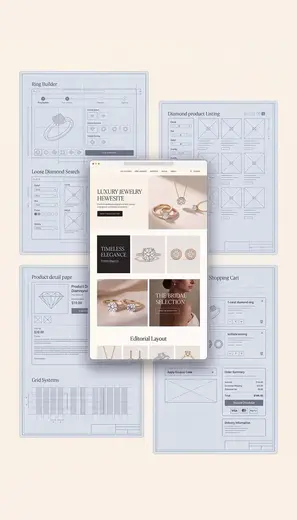
Brand & visual experience
Luxury positioning begins with art direction, typography, whitespace and consistent product scale—not a purchased “luxury” theme.
Product discovery
Collections, diamond search and filters must help novices progress while serving knowledgeable stone buyers.
Product confidence
High-resolution views, 360° media, certificates, sizing, delivery, returns and warranty answer the questions that arise online.
Customisation
Ring, pendant and earring builders connect choices to valid combinations, live pricing and a reviewable final product.
Commerce & conversion
Add-to-cart, enquiry, consultation, wishlist, compare and share should match the way your customer decides.
Backend & operations
Supplier sync, data normalisation, metal rates, markups, currencies, languages and analytics keep the front end commercially useful.
Business-model design
One jewelry template cannot serve every jeweler.
The product story, buying path and operations change with the way the business sells.
Local reputation, appointments, store services and a manageable catalogue should work together.
Education, diamond discovery and compatibility-driven journeys take priority.
Portfolio, consultation, process and expectation-setting matter more than catalogue size.
Fast search, tiered access, price permissions and repeat ordering shape the product.
Separate permissions, pricing and journeys must share data without confusing either audience.
Platform-selection guidance
Choose for the business you are building.
There is no universally best website platform for a jewelry store. The answer depends on catalogue complexity, ownership, integrations, team and long-term plans.
Jewelry requirement
Shopify / Plus
WooCommerce
Magento
PrestaShop
Custom
Lean team / managed operations
High
Med
Low
Med
Low
Diamond search & builders
Med
High
High
High
High
B2B / multi-store rules
Med
Med
High
Med
High
Ownership & code control
Low
High
High
High
High
International selling
High
Med
High
High
High
Hosting responsibility
Low
Moderate
High
Moderate
Highest
TPS principle: platform selection follows the commercial model and internal capacity—not market fashion.
Integration reality: the same supplier feed may need a different architecture on hosted, open-source and custom stacks.
Proof, not promises
Specialist functionality should be visible.
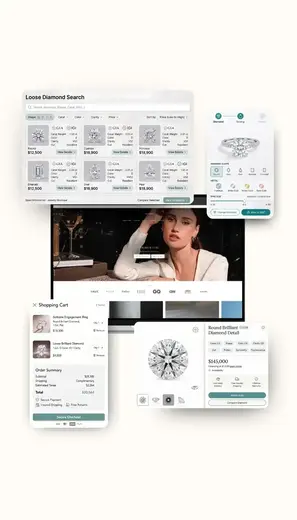
These fragments illustrate TPS capabilities. They are demonstrations—not generic templates presented as client work.
TPS capability demonstration · Loose diamond search
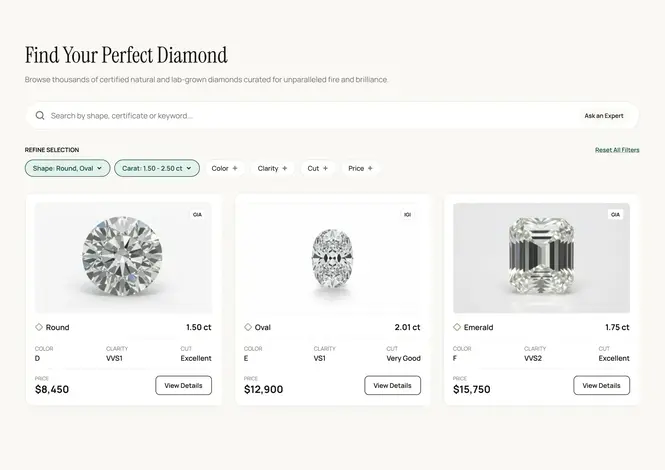
Normalised data · Markups · Certificates · 360°Open live demo ↗
TPS capability demonstration · Mobile ring builder
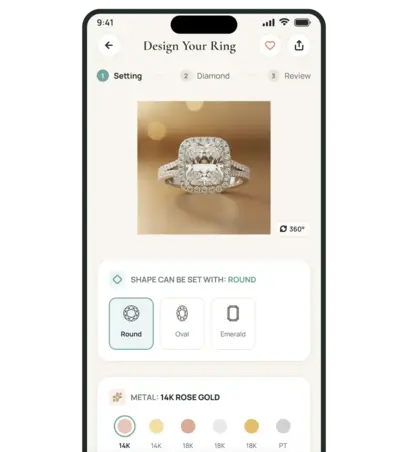
Setting-first · Diamond-first · Save & shareExplore ↗
Patterns TPS encounters
Common jewelry website mistakes.
The expensive problems usually begin before development—with missing rules, generic assumptions or an unclear buying model.
Collections, filters, builders and SEO later require rework because the catalogue was not structured.
Unnormalised fields, duplicate stones, missing media and unmanaged markups reach customers.
An invalid stone-and-setting order reaches sales after the buyer believes the ring is complete.
Changing angles, scale, shadows and colour temperature make a premium catalogue feel assembled.
High-value videos become a mobile loading problem; buyers leave before proof appears.
Valuable product, collection and editorial URLs disappear and visibility is reset unnecessarily.
TPS engagement process
Understand the sale before choosing technology.
TPS works as a strategic and technical partner. Requirement review comes before design because the journey depends on the product and operating model.
Discuss your requirement
Business discovery
Customer, product, margin, stock, fulfilment, B2B/B2C and assisted-sales model.
Requirement & platform evaluation
Scope capabilities and choose technology against current and future needs.
Journey & data planning
Define navigation, search, compatibility, imagery, feeds, pricing and administration.
UX & visual direction
Create a distinctive interface grounded in the brand and buying journey.
Development & integration
Build commerce, supplier connections, builders and backend controls.
Testing, launch & training
Verify rules, responsive behaviour, browsers and speed; launch and prepare administrators.
Post-launch support
Support the live store and use observed behaviour to guide improvement.
18+years in jewelry e-commerce
4core commerce platforms
7+supplier and feed types
Globalinternational-market experience
Expert consultation
Tell us how your jewelry business sells.
We’ll help you plan how the website should work—before you commit to a platform, theme or feature list.
- Jewelry-specific discovery
- Platform and integration perspective
- Preliminary scope discussion
- NDA available where required
For international jewelry retailers, manufacturers and diamond wholesalers.
Practical answers
Jewelry website design
Jewelry website design
FAQs.
Answers to questions TPS hears from retailers planning, replacing or extending a store.
How much does a jewelry e-commerce website cost?
Cost depends on catalogue complexity, original design, feeds, builders, currencies, languages, B2B rules and migration work. A module can be scoped separately; a ground-up international store needs discovery before a meaningful estimate.
How long does development take?
A typical project may take around 6–12 weeks after requirements and design approval. Complex integrations or large catalogues can take longer, and data, imagery and feedback readiness materially affect the schedule.
Which platform is best for a jewelry store?
There is no universal winner. Shopify suits managed operations; WooCommerce offers flexibility; Magento serves complex enterprise requirements; PrestaShop supports international open-source commerce; custom work is justified when the model exceeds platform conventions.
Can TPS redesign an existing jewelry website?
Yes. TPS can redesign within the platform, add specialist modules or recommend migration when the architecture is the constraint. First separate visual problems from data, performance, integration and conversion issues.
Can existing SEO be preserved?
It can be protected with a URL inventory, redirect plan, content and metadata mapping, canonical and indexation checks, analytics continuity and monitoring.
Can Shopify or WooCommerce support a ring builder?
Yes. TPS develops setting-first and diamond-first flows, shape and size compatibility, natural and lab-grown options, engraving, save-and-share, dynamic prices and valid cart combinations.
Can TPS integrate Nivoda, RapNet, IDEX or VDB?
Yes. Work normally includes authentication, field normalisation, synchronisation, filters, markup rules, certificate and 360° media handling and availability checks.
Can natural and lab-grown diamonds be sold together?
Yes, but they should be intentionally classified and explained. Search labels, education and price presentation should help buyers understand the comparison.
Are currencies and languages supported?
Yes. Scope should cover display and settlement, rates, tax or VAT, translated catalogue fields, URL structure and operational ownership—not only a switcher.
Does TPS provide support after launch?
Yes. Support can cover fixes, platform and integration maintenance, incremental improvements and coordination around the live store. The exact model is defined in the proposal.
Can TPS develop only a specialist module?
Yes. Diamond search, supplier integration, ring, pendant or earring builders can be scoped without rebuilding the entire site when the platform and codebase support the work.