

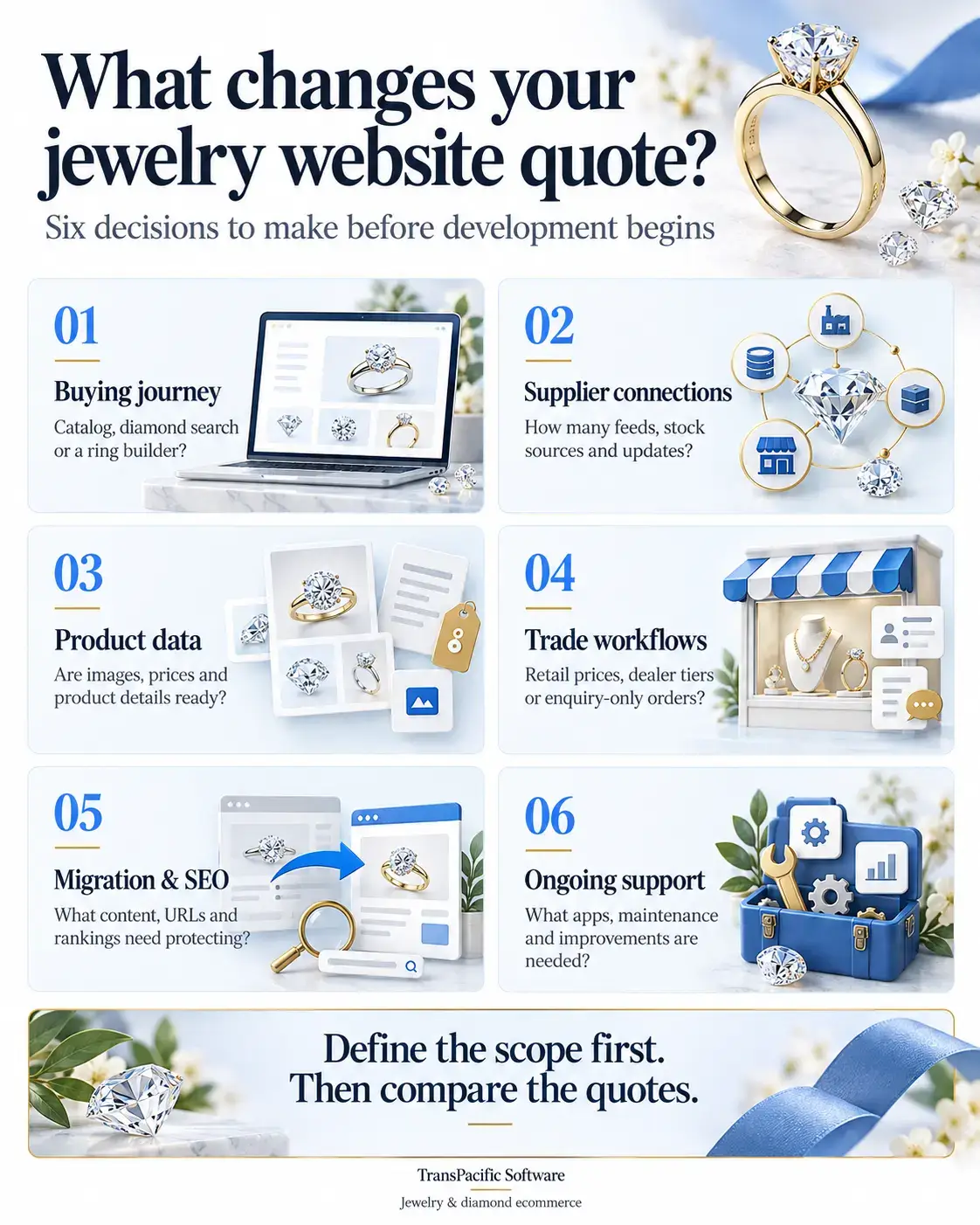
The cost of a custom jewelry website depends on what customers need to do, where your product information comes from, and how your business prices and fulfils orders. A store selling finished jewelry has different requirements from a diamond website with live supplier inventory, trade pricing and a ring builder.
At TransPacific Software, our pricing conversations usually begin with questions about these requirements. The number of pages tells us surprisingly little about the work involved.
A single diamond-search page can require more development than several information pages combined.
This guide explains what changes a quote, how to compare proposals, and when a specialist jewelry ecommerce developer adds value.
What does a jewelry website actually cost?
For a starting reference, TPS’s published pricing currently distinguishes these scopes:
| Project scope | Published starting price |
|---|---|
| Starter diamond API integration | $1,200+ |
| Diamond search with a ring builder | $3,700+ |
| Ring, pendant and earring builder package | $8,500+ |
| Complete custom jewelry ecommerce store | $16,000+ |
These are starting frameworks, not interchangeable website packages. Adding a module to an existing store is different from building the complete store. Final inclusions and pricing depend on the agreed requirements. See the TPS pricing page, checked on 7 October 2026.
The most useful question is therefore: “What exactly does this price include for my business?”
1. Are you building a store, adding a feature or creating a marketplace?
These are different projects, even if all three display diamonds.
An existing retailer might need a diamond-search feature added to a working website. Another business might need the complete store: design, navigation, jewelry collections, checkout, content and integrations.
A marketplace introduces another question: will multiple suppliers manage their own listings?
In a recent B2B enquiry, our first response asked whether the prospect wanted to improve the existing platform or build a marketplace where suppliers could list and manage their diamonds.
That distinction changes the scope before design begins.
Our proposals also separate deliverables such as custom themes, educational pages, language, currency, diamond search and product builders. Ask your developer to make those boundaries visible.
2. What does “diamond feed integration” include?
Name the supplier, diamond categories and required behaviour. “Connect the API” is not a complete specification.
In our correspondence, we ask:
- Natural diamonds, lab-grown diamonds, or both?
- White diamonds, fancy colours, or both?
- One supplier or several?
- Supplier inventory only, or your own stock too?
- Search and enquiry, or purchasing through checkout?
One pricing discussion required us to clarify what counted as a feed. Different diamond categories from the same supplier were treated as separate scoped datasets.
That is not a universal pricing rule. It is a reason to define the term before comparing quotes.
If your suppliers already provide one consolidated dataset, show it to the developer. The estimate should reflect what can be reused and what still needs mapping, filtering, pricing and testing.
The number of supplier names alone does not measure the work.
3. How sophisticated is your buying journey?
A ring builder needs more than three attractive screens.
One TPS proposal described both starting routes: choose a setting first, or choose a diamond first. It also specified temporary mounting data that would later be replaced with the client’s own data.
That creates practical questions:
- Which diamond shapes and sizes fit each setting?
- Which metal and ring-size choices are available?
- How is the combined price calculated?
- Which images should change with the selection?
- What information reaches the order?
Pendant and earring builders introduce additional requirements rather than simply duplicating the ring screen.
Our Shopify ring builder overview helps explain the customer journey. Your quotation should describe the rules behind that journey, along with who supplies the setting data.
4. Is your product data ready?
Data preparation is real project work.
During one catalog assignment, our report identified missing metal colours, missing prices, duplicate product codes and classifications needing review. Additional images and product variations also needed expansion beyond the initial review file.
A spreadsheet containing thousands of rows is not necessarily ready for publication.
For jewelry, small distinctions matter. Metal purity does not establish metal colour. A setting without a centre stone must be distinguishable from a finished ring. An inferred style should not become a confirmed product description without checking.
Ask who will:
- Clean and organise the data.
- Write or revise descriptions.
- Match images to products and options.
- Resolve missing prices and attributes.
- Review sample imports before publication.
A proposal assuming that you provide clean data will differ from one including that preparation. Both can be reasonable, provided the responsibility is explicit.
5. Do different customers need different prices or ordering options?
A retail store and a trade portal may look similar while operating differently.
Our B2B discussions have included customer groups with different markups, supplier feeds alongside in-house inventory, and separate buying or memo-request options.
These requirements need clear rules.
Who assigns a buyer’s pricing group? Which price does that buyer see? Is an action a confirmed purchase or a request requiring approval? What should happen when stock changes?
Custom orders add another layer. Our discovery correspondence has included image submissions, modification requests, made-to-order pieces and deposits.
A simple enquiry form and a complete custom-order process should be quoted separately. Explain what happens after the customer clicks “Submit,” not just what the form looks like.
6. Are you replacing an existing website?
Migration adds work that a new store may not require.
Our migration documents cover products, customers, historical orders, reviews, useful content and existing integrations. They also include trial transfers, checking record counts, redirect planning and launch testing.
The existing website’s condition matters too. In one client exchange, restoring an older Magento store involved its server, operating system, platform and plugins.
Before quoting, establish whether the project includes temporary repairs, the new build, data transfer, or all three.
Our jewelry website migration service outlines the areas to discuss. Ask specifically whether the proposal includes SEO migration and testing existing page addresses after launch.
Generalist developer or jewelry ecommerce specialist?
A capable generalist can be a sensible choice for a straightforward store with standard products and purchasing. Specialist experience becomes more valuable as diamond data, configurable jewelry and trade workflows become central.
The distinction should be demonstrated through relevant knowledge, working examples and a clear scope.
| Area | Standard ecommerce requirement | Additional jewelry-specific questions |
|---|---|---|
| Products | Titles, prices, images and stock | Semi-mount or finished piece? Which metal, stone and size combinations? |
| Search | Categories and basic filters | Which diamond attributes and category-specific filters are needed? |
| Pricing | Product price and discounts | Supplier markups, buyer groups, diamond-plus-setting totals? |
| Inventory | Update available quantities | How are supplier changes, sold stones and failed updates handled? |
| Ordering | Add to cart and pay | Complete ring, custom order, deposit, quotation or memo request? |
These questions reflect the requirements appearing in TPS’s project discussions and planning.
When assessing a specialist, ask for a demonstration using a product similar to yours. Then introduce an exception: a missing price, incompatible setting or unavailable stone.
Ask what the system does and how the retailer is informed.
A specialist label alone proves little. The value is in identifying relevant problems early and including their handling in the agreed work.
What costs continue after development?
Separate the initial project price from the cost of operating the store.
Our correspondence raises app costs and support arrangements because they affect the overall budget. Depending on the solution, continuing expenses can include:
- Ecommerce platform or hosting.
- Apps and supplier services.
- Payment processing.
- Integration maintenance and technical support.
- New features requested after launch.
Also clarify ownership. A custom development agreement, a licensed product and a subscription app may offer different rights and responsibilities.
Ask what is handed over, what remains dependent on third parties, and what happens when support ends. Our project discussions distinguish support, future development, documentation and handover rather than treating them as one undefined promise.
How can you reduce the budget sensibly?
Reduce the first release’s scope deliberately.
In one trade-project discussion, we revisited the minimum requirements and considered postponing a builder. Other conversations separated catalog integration from additional buying tools.
Useful decisions include starting with fewer inventory categories, supplying cleaned product data, or deferring secondary features.
Write down what is postponed and whether preparing for it now affects the initial build.
Our correspondence also shows why repeated scope changes require recalculating development effort. Agreeing the essential first release gives both sides a more reliable basis for pricing.
What should you send to get a meaningful quote?
Send your current website, target customers, platform preference, supplier details, sample product data and essential buying journeys.
Include your budget and list features as required at launch, useful later, or not needed.
Then compare proposals against the same requirements: deliverables, exclusions, data responsibilities, testing, recurring costs, ownership and support.
The right quote should help you understand what you are buying and how it supports your business.
Contact TransPacific Software with your website and requirements for a practical scope and quotation.